I’ve said in the past that I find posts written all in lower case to be hard to read, and I stand by that. I need a few capital letters here and there to get my bearings.
But that doesn’t mean I don’t have an appreciation for lower case. In fact I downright prefer it.
Capital letters have a boring lack of variety. They’re all the same height and they’re all kind of blocky. Sure they should be used, but sparingly.
Lower case letters have so much more diversity: half height (like a, c or e), three-quarters height (like t), or full height (with an ascender like b or d). Or a descender that takes them below the line: g, j, p, q, y.
There’s a reason you never see an entire sentence written in all caps. It’s even harder to read than all lower case. Radio announcers write their copy in all caps for this very reason. It forces them slow down and enunciate.
Let’s check out some particularly appealing lower case letters. If you’re not using serifs, you should switch so you can see how beautiful letters can be.
Two of my favourites are the ones with a tittle: i and j. You won’t find any capital letters with dots over them — at least not in English.
Another favourite is g: I love the loop on the bottom and the stem poking out the top.
And look at this a: See how nicely it curves on the top and leaves a bowl underneath — all in the space of half a capital.
Then there are the ligatures. Two f’s join as ff. An f and an i become fi. This is artistry you won’t see among the upper case.
The only real competitor among the capitals is Q with its swooping tail.
But what about headings? Write them like you would a sentence, but without a period at the end — no capitals unless necessary. And that includes what is known as title case.
With title case, pretty much every word is capitalized with the exception of some shorter words. The trouble with writing a heading as if it were a title is that real titles get lost in them. Suppose you want to put the title of book in your heading. If all the words are capitalized, it’s hard to know where the book title begins and ends.
A great use of lower case is Apple’s naming of some of its products with lower case letters at the beginning. For example, I’m writing this on an iMac, which runs on macOS. Do not be one of those pedants who insist on writing “MacOS.” I have no idea what they are trying to prove.
When the comics character Pogo said, “We have met the enemy and he is us,” he was referring to pollution. He might have said the same thing about the dreaded algorithm.
In a recent post at Skuthus, Skyler points out that the Bear Discover “trending list is full of naysayers, warnings, dire laments, and gripes.”
For those of taking us refuge in the indie web to get away from all that, Skyler’s conclusion hits hard.
“I just think the mudslinging should be minimized or the big guys will win, having proven that it's not them who are spreading the hate and negativity — it's US.”
The algorithm tries to feed us what we want. And if it’s feeding us negativity, we might want to reflect on that.
I looked at some trending posts on Bear Discover, and came up with positive alternatives. Would you have upvoted these, or would you have preferred the originals? I have to admit the negative versions do seem more compelling.
Original: F*ck Omarchy and right wing populism Alternative: Check out this awesome alternative to Omarchy
Original: For the last time I’m not downloading your stupid app Alternative: Use these browser extensions to avoid app requests from social media
Original: How to endure Instagram Alternative: How to enjoy Instagram
You’re driving along the information superhighway when suddenly you hear a siren, so you pull over. It’s the internet police.
The officer gets out and comes over to your window.
“What seems to be the problem, officer?”
“I had to pull you over because I noticed you used the word ‘lay’ incorrectly in one of your blog posts.
“You wrote that you were going to ‘lay low over the weekend’ when you should have written ‘lie low.’ Lay is a transitive verb, which means you’re doing something to something else. Examples would be ‘lay some bricks’ or ‘lay an egg.’ If you’re doing something on your own, you need an intransitive verb — in this case ‘lie.’ You can ‘lie on the couch,’ for example, or ‘lie low.’
“Every time I see someone write ‘lay’ when they mean ‘lie,’ I wonder what it is they are laying. So when you wrote ‘lay low,’ I had crazy thoughts about you laying some low bricks.
“When Bob Dylan sings, ‘Lay, lady, lay, lay across my big, brass bed,’ I ask myself what she could possibly be laying.
“It makes no sense.”
“Sorry, officer. It’s tricky trying to remember the difference between ‘lay’ and ‘lie,’ but I’ll try to do better in the future.”
“OK, I’ll let you off with a warning this time, but if it happens again you might get a ticket.”
WHO – An author you would love to have a ‘one to one’ with?
The author who comes to mind is Corey Doctorow. I mostly like his science fiction and I resonate with his essays on modern technology. My main fear is that I would not be able to hold my own, and he would soon be bored. The only well-known author I have spoken to was Timothy Findley, and I do believe he was bored though too polite to say so. I once exchanged emails with Andy Weir, who somehow seemed like just a regular guy.
WHAT – What genre do you most gravitate to?
If you go by sheer volume, the answer would have to be science fiction. But it’s the realm of speculative fiction that has the most power to pull me in. I’m fascinated by books like Piranesi, The Memory Police and The Other Valley. They take me to an impossible place and make me believe it’s real.
WHERE – Where do you prefer to read?
I mostly like to lounge on the couch and it needs to be quiet.
WHEN – What time of day do you prefer to read?
It seems to happen more in the afternoon and evening. It’s almost like I have to work my way up to reading because it feels like a commitment.
WHY – Why is your favourite book your favourite book?
I appreciate the way The Lord of the Rings takes me into another world complete with its own history, languages and peoples. It’s an epic where good wins but at a cost. That would be the one book I would take to a desert island because I would never tire of reading it.
BONUS — How do you go about selecting what you will read next?
I follow a lot of RSS feeds about books or where books are likely to be mentioned. If one of them catches my interest, I see if it’s in Libby and go from there. I’ve been gravitating toward Canadian writers because I like the feeling of stories in familiar places involving familiar people. Here are a bunch I have read in recent years.
The top comment (as of this writing) summed things up well: “It's exactly because Firefox is so important that you'll see people here complaining when Firefox does things to push away users . . .”
Overall, the passion for Firefox was on full display. I hope Mozilla staffers take this thread as feedback and use it to improve Firefox in ways that boost market share.
I kind of regret my reference to “over thinkers on Hacker News” because it could be taken as an insult. A casual glance around this site, though, will show that I do plenty of overthinking myself.
I recall one time when someone accused me of overthinking something, I shot back that he was underthinking it. Ah, those were the days.
A comment about the moving background being “nauseating” caught my attention. It didn’t exactly move, but the stars fading in and out for a twinkling effect could give that impression.
I myself found the twinkling stars distracting, not just because of the twinkles but also because it is improbable that stars would appear this way in outer space, which is what this is supposed to depict.
So I’ve commented out a couple of lines of CSS and stopped the twinkling. I also stopped the barely perceptible wisps of cloud from blowing by.
The stars are based, by the way, on a video by Carla Notarobot. This was from six years ago, so chances are Carla really was not a robot.
Finally, it’s comments like these that make me love Hacker News:
“wait, is this a thing? firefox is the only mainstream browser with an rcfile, that alone gives you incredible powers. I hope one day it also grows something like chrome's CDP. What is everyone so upset about?”
I checked the Wikipedia article, and still only have a vague idea of what an rcfile is.
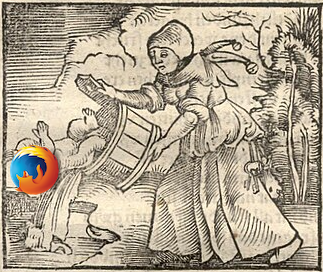
According to Wikipedia, it’s an adage that goes back to 1512 in Germany. People have known for hundreds of years that you should be careful not to throw out a good and vital thing in your zeal to get rid of a minor annoyance.
I think about this when I see people dumping on Firefox.
The latest was a post from a prolific blogger who has switched to Vivaldi because Firefox is now on X. He is somehow able to reconcile this with the fact that Vivaldi is also on X — not to mention Meta’s Threads, Facebook and Instagram, along with Google’s YouTube.
Meanwhile, the over thinkers on Hacker News come up with convoluted reasons to hate on Firefox every time the subject arises. It makes me wonder if it’s a bot campaign by Google — except, why would they bother?
Firefox is our last best hope for browser engine diversity and competition. Without it we would be stuck with Google Chrome and its spinoffs everywhere (including Vivaldi). The only holdout would be Apple Safari, hanging in there only because it’s the enforced default on iPhones.
I’m sure the reason Firefox is on X is because they’re hoping to reach out to new users. Considering their small and diminishing market share worldwide, they desperately need to reach out wherever they can.
During the last week, 39 per cent of visitors to Newsonaut were using Linux. That’s about as hard-core indie as you can get when it comes to systems. And it was ahead of all the others.
Although I’m on macOS myself, I’m glad to see that my small indie contribution is making headway among Linux users. I respect their do-it-yourself spirit.
I was a little disappointed, though, to see that Chrome is the top browser with 60 per cent. I’d love to see Firefox doing better than a measly 12 per cent. Still, it’s pretty decent compared with the tiny 3.3 per cent worldwide in July.
By the way, I’m getting these stats from GoatCounter, a donation-supported open source analytics platform that I use to satisfy my curiosity. It’s all general stuff, nothing about individual visitors.